Average House Height in the UK: A Clear 2026 Guide
Last Updated: June 19, 2026

Introduction
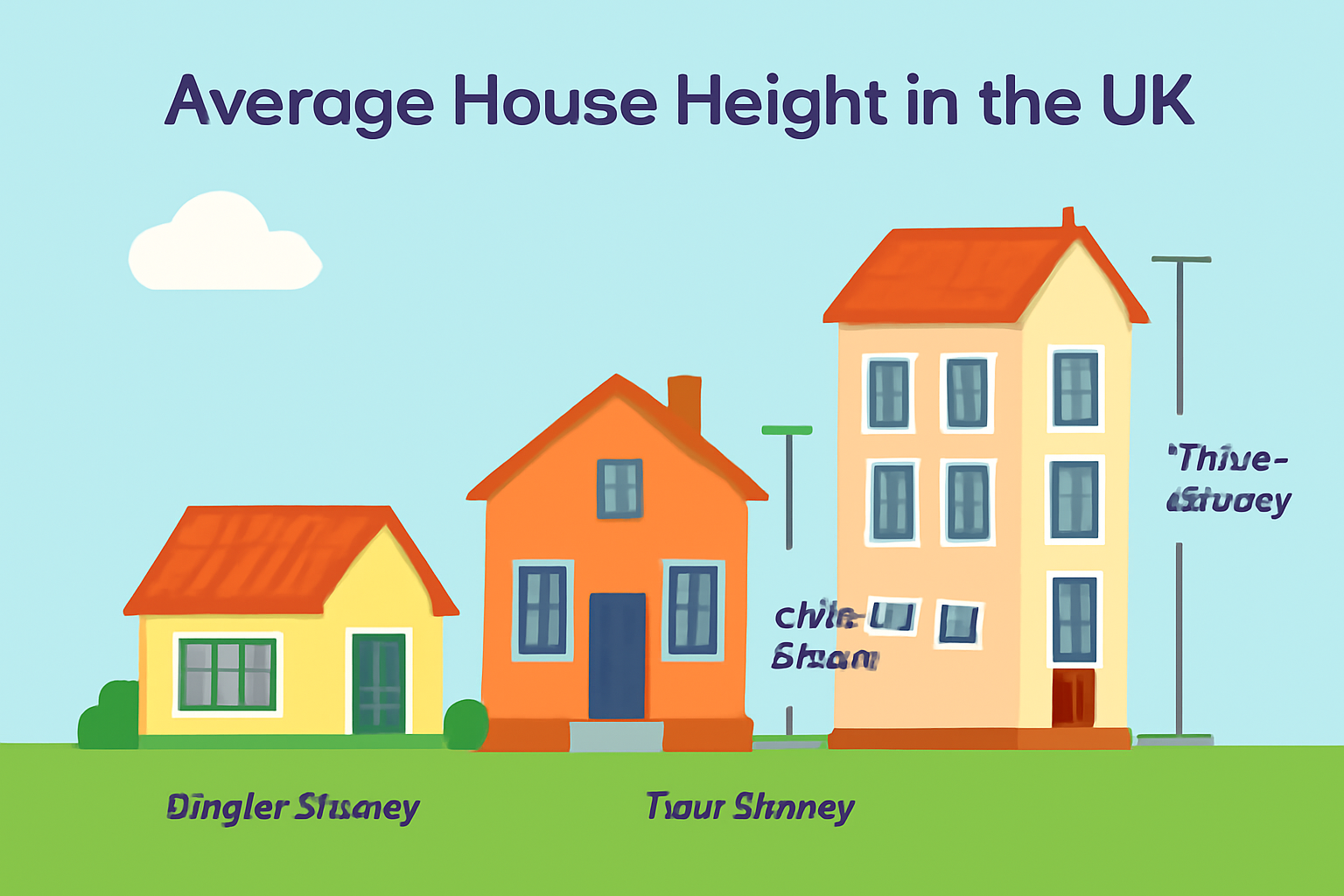
The average house height in the UK is usually between 6 and 8 metres for a standard two-storey home, measured from ground level to the highest part of the main roof. However, this is a practical estimate rather than one fixed legal measurement. The final height depends on the number of floors, ceiling levels, floor construction, roof pitch, property age and architectural design.
A bungalow may be only 3 to 5 metres tall, while a three-storey townhouse can reach 9 to 12 metres. Older Georgian and Victorian homes may also stand higher than newer properties because of their generous ceiling proportions and steeper roofs. Anyone planning construction should consider the building’s full dimensions alongside the cost of building a home, local planning policy and structural requirements.
Quick answer: A typical two-storey UK house is around 6 to 8 metres, or approximately 20 to 26 feet, from ground level to the roof ridge.
Average House Height in the UK at a Glance
| Property type | Common overall height | Approximate height in feet |
|---|---|---|
| Single-storey bungalow | 3–5 metres | 10–16 feet |
| Two-storey house | 6–8 metres | 20–26 feet |
| Two-storey house with a steep roof | 7–9 metres | 23–30 feet |
| Three-storey house | 8.5–11 metres | 28–36 feet |
| Three-storey townhouse | 9–12 metres | 30–39 feet |
| Modern flat-roof home | Varies by storeys | Varies |
These figures are broad residential estimates. They should not replace an architect’s drawing, measured survey or official planning assessment.
What Does House Height Actually Mean?
People sometimes use “house height” to describe several different measurements. Understanding the correct term is important because ceiling height, eaves height and ridge height do not mean the same thing.
Overall Building Height
Overall height normally describes the vertical distance between ground level and the highest part of the main roof. On a pitched roof, this is usually the ridge.
Chimneys, aerials, vents and other small projections may be treated differently depending on the purpose of the measurement. Planning authorities can also apply specific rules when deciding where ground level begins, especially on a sloping site.
Eaves Height
The eaves are found where the roof slope meets the outside wall. A two-storey property may therefore have an eaves height of roughly 5 to 6 metres but a higher overall ridge level.
Eaves height becomes especially important when planning rear extensions, side additions, garages and buildings close to a boundary.
Ridge Height
The ridge is the highest horizontal line of a traditional pitched roof. A steep gable roof creates a higher ridge than a shallow-pitched or hipped roof built above walls of the same height.
Floor-to-Ceiling Height
Floor-to-ceiling height is measured inside a room from the finished floor surface to the finished ceiling.
Many modern homes have internal ceilings of approximately 2.3 to 2.4 metres. Period properties may have taller rooms, although dimensions vary greatly between individual buildings.
Floor-to-Floor or Storey Height
Storey height is measured from one finished floor to the next. It includes the visible ceiling height plus floor joists, structural material, insulation, service space and ceiling finishes.
A domestic storey may therefore have a floor-to-floor dimension of around 2.7 to 3 metres even when the internal room height is closer to 2.4 metres.
Typical Height of a Two-Storey House
Most British detached, semi-detached and terraced family homes have two main storeys. Their walls and floor structure usually create around 5 to 6 metres of height before the upper roof space is counted.
A pitched roof may add another 1.5 to 3 metres. This produces the familiar overall estimate of approximately 6 to 8 metres, although taller roofs, raised foundations and generous ceiling levels can move a property beyond that range.
Two neighbouring homes can have the same number of floors but different ridge heights. Roof shape, loft space, ground slope and architectural period all affect their external profile.
Typical Height of a Bungalow
A bungalow has one principal living level, but its total height is greater than its internal ceiling measurement. The external walls, roof structure and foundation level must also be included.
A standard bungalow may be around 3 to 5 metres high. Properties with steep pitched roofs, dormer rooms or converted lofts can stand considerably taller.
A dormer bungalow may look like a one-and-a-half-storey home because bedrooms or other rooms have been created within the roof space.
Typical Height of a Three-Storey House
A three-storey property commonly measures between 8.5 and 11 metres. Some traditional townhouses and narrow urban homes can approach 12 metres when they have high ceilings, raised entrance levels or steep roof structures.
Three-storey homes are often found in city neighbourhoods where builders use vertical space to provide more rooms on a limited plot. Their appearance may be narrow from the front but deep or tall in overall proportion.
Height can affect value, maintenance access and buyer expectations. It is therefore one of several physical details worth checking alongside the usual questions about how long a house sale takes.
The Architectural Biography of British House Height
The height of a British house tells part of its architectural biography. Its proportions can reveal the era in which it was built, the materials available at the time and the lifestyle its original designers expected.
This historical background does not create an exact measuring rule, but it helps explain why neighbouring streets can contain very different rooflines.
Georgian Properties
Georgian architecture is known for balanced front elevations, vertical windows and formal proportions. Larger Georgian homes often have generous ground-floor rooms and high ceilings.
Some properties also have lower service rooms, basements or attic accommodation. Their full height may therefore be greater than the number of obvious floors suggests.
Victorian Houses
Victorian housing includes everything from compact workers’ terraces to large villas. Many surviving examples have tall front windows, decorative gables, chimney stacks and comparatively spacious principal rooms.
Their roof pitch and internal proportions can make them appear taller than later homes with the same storey count.
Edwardian Homes
Edwardian houses often continued the use of comfortable ceilings and strong roof forms while introducing wider layouts, larger windows and brighter rooms.
Bay windows, front gables and substantial loft spaces contribute to the distinctive identity of many Edwardian streets.
Interwar and Post-War Housing
During the interwar and post-war periods, housebuilding increasingly focused on practical layouts, standardised construction and efficient use of materials.
Many semi-detached homes from these eras have simpler rooflines and more modest internal proportions than grand period properties. However, large variations still exist between estates and regions.
Modern New-Build Homes
Modern houses are shaped by planning density, insulation, energy performance, construction cost and internal space standards.
Their ceilings are commonly around 2.3 to 2.4 metres, although premium homes and custom-built properties may use taller rooms to create a brighter and more open atmosphere.
This timeline shows how the background, development and evolution of British housing have influenced the height and character of today’s residential streets.
Is There a Legal Minimum Ceiling Height in the UK?
There is no simple rule stating that every existing UK room must have one universal ceiling height. Requirements depend on the project, building type, planning conditions and national jurisdiction.
In England, the government’s nationally described space standard states that the floor-to-ceiling height should be at least 2.3 metres across at least 75% of a qualifying dwelling’s gross internal area.
This space standard should not be described as a general rule controlling the total height of every British house. It is also different from regulations covering staircase headroom, fire safety, ventilation and structural work.
Building and planning systems are not identical across England, Scotland, Wales and Northern Ireland. Homeowners should therefore check the rules that apply in their own nation and local authority area.
Stair Headroom and Loft Space
Normal domestic stairs are generally designed to provide at least 2 metres of clear headroom above the pitch line and landings. Certain loft-conversion situations may allow reduced headroom where full clearance cannot reasonably be achieved.
A loft room also needs more than a high central ridge. Designers must consider usable floor area, insulation thickness, escape arrangements, fire protection, structural support and a safe staircase.
Areas beneath a sloping roof may provide storage but may not offer enough standing height for comfortable daily use.
Do Loft Conversions Increase House Height?
A loft conversion does not always raise the roof. Rooflight conversions can often use the existing roof structure without making a major change to the external height.
Dormer conversions alter the roof shape to create more standing space, but they may still remain below the original ridge. Under common permitted-development conditions in England, a roof extension must not exceed the height of the existing roof.
More complex projects may involve raising the ridge, changing the roof pitch or replacing the entire roof. These works are more likely to need planning permission and detailed structural design.
Anyone considering roof work should review the official permitted development guidance for householders and speak to the local planning authority before construction begins.
How Roof Design Changes the Total Height
The roof can contribute a large part of a house’s external measurement.
Gable Roof
A gable roof has two slopes meeting at a central ridge. A steep pitch creates useful loft volume but increases the full building height.
Hipped Roof
A hipped roof slopes down on several sides. Its ridge may be shorter than that of a comparable gable roof, although the highest point can be similar.
Mansard Roof
A mansard roof uses steep lower slopes and a shallower upper section. It can create valuable upper-floor space but may significantly change the building’s appearance.
Flat Roof
A flat roof keeps the overall structure lower because it does not need a high ridge. It is often used on modern houses and extensions, though it still requires a slight drainage fall.
Dormer Roof
A dormer projects from the main roof slope to provide windows and improved internal headroom. It changes the building’s profile even when it stays below the ridge.
Other Factors That Influence Residential Building Height
Ground Conditions
A home built on sloping land may appear much taller from the rear than from the front. A basement, raised floor or retaining wall can also affect the visible elevation.
Foundation and Floor Level
Flood risk, drainage requirements and site preparation may require a raised finished floor level. This can increase the distance between surrounding ground and the roof.
Ceiling Proportions
Higher ceilings can make rooms feel bright and spacious. They also increase the amount of air inside the room, though energy performance depends on insulation, airtightness, ventilation, glazing and the heating system rather than ceiling height alone.
Suitable window design and ventilation remain important in every property. Homeowners dealing with excess moisture can also review practical steps for stopping condensation on windows.
Roof Pitch
A steep roof increases ridge height and can provide more attic volume. A low pitch reduces the roof profile but may limit usable loft headroom.
Local Character
Planning authorities often assess how a proposed home or extension fits the street scene. The surrounding ridge line, neighbouring eaves, building materials and established architectural character may influence what is acceptable.
Conservation Requirements
Listed buildings and homes in conservation areas may face tighter controls. Their roof shape, historic proportions and visual heritage may need to be preserved.
Why House Height Matters
House height influences more than external appearance.
It can affect:
- Planning permission and permitted-development rights
- The amount of natural light entering neighbouring properties
- Privacy and overlooking
- Loft-conversion potential
- Staircase and headroom design
- Roof maintenance and gutter access
- Scaffolding and repair costs
- Heating volume and ventilation
- Solar-panel position
- Views and street character
- Shadowing in gardens
- Building insurance and survey details
Taller rooms may also need a more thoughtful lighting plan because one central ceiling fitting may not illuminate the full space evenly. Layered lighting can work better, as explained in this guide to the best lighting for bedrooms.
House Extensions and Height Limits
An extension cannot simply be built to any preferred height. Its eaves, ridge, position, distance from boundaries and relationship with the original house may all be controlled.
In England, some projects can be completed through permitted-development rights, but those rights contain detailed conditions. They do not remove the need to comply with building regulations or other legal requirements.
A local planning authority may expect a two-storey extension to remain visually secondary to the original house. Its roofline may need to sit below the main ridge to prevent the addition from dominating the property.
The extension’s scale can also change shade, privacy and the amount of usable outdoor space. A balanced layout should preserve enough room for practical landscaping or small garden ideas.
How to Measure the Height of a House
For a basic estimate, measure from the ground at the outside wall to the roof ridge. Never climb onto a roof merely to obtain a measurement.
Safer methods include:
- Using a laser distance meter from a suitable position.
- Measuring a known wall feature and comparing proportions in a straight photograph.
- Using survey drawings or approved planning plans.
- Asking a building surveyor to carry out a measured survey.
- Checking architectural drawings supplied with a recent extension or new build.
For legal, planning, boundary or construction purposes, use a professionally prepared measurement. Informal estimates can be affected by sloping land, perspective and unclear ground levels.
Common Mistakes When Estimating House Height
One common mistake is multiplying the ceiling height by the number of floors. This leaves out floor thickness, roof space, foundations and structural zones.
Another error is measuring only to the eaves and describing that figure as the complete building height. The ridge of a pitched roof may stand several metres higher.
It is also incorrect to assume that every modern house follows exactly the same dimensions. Developers, architects, planning authorities and site conditions can produce different results.
Finally, a planning height limit should not be confused with a typical residential average. One describes what may be legally allowed in a particular situation; the other is only a general estimate of common buildings.
Frequently Asked Questions
What is the average house height in the UK?
A typical two-storey UK house is approximately 6 to 8 metres high when measured from ground level to the main roof ridge.
How tall is a two-storey house in feet?
It is commonly around 20 to 26 feet tall, although some period homes and steep-roof properties are higher.
How tall is a bungalow?
A standard bungalow is usually around 3 to 5 metres high, depending mainly on its wall height and roof pitch.
What is the usual ceiling height in a modern UK home?
Many modern homes have ceilings of approximately 2.3 to 2.4 metres, but there is no single measurement used in every property.
Are Victorian houses taller than modern houses?
Many Victorian properties have taller principal rooms and steeper roofs, but the period includes many different building types and dimensions.
Does a loft conversion make a house taller?
Not necessarily. Many loft conversions remain within the existing roof height, while projects that raise the ridge may require planning permission.
Is eaves height the same as total house height?
No. Eaves height is measured where the roof meets the wall, while total height normally reaches the highest part of the main roof.
Do house-height rules apply across the whole UK?
No single planning framework covers every project in all four nations, so local and national guidance should always be checked.
Final Thoughts
The average house height in the UK is best understood as a range rather than a fixed number. Most two-storey homes stand around 6 to 8 metres tall, while bungalows are generally lower and three-storey townhouses are considerably higher.
The number of storeys provides a useful starting point, but roof pitch, ceiling level, floor structure, foundations, ground slope and architectural period all shape the final measurement. For a renovation, loft conversion, extension or new build, a professional measured survey and local planning advice provide far more reliable information than a general online estimate.